8. Outlook for the compensation framework 2026/27
As indicated previously, the NCC conducted a comprehensive review of Sonovaʼs compensation framework in the 2025/26 financial year with the support of the compensation consultant HCM International Ltd., and identified opportunities to simplify and further align with the strategic, organizational, and cultural repositioning under the new leadership. The following changes to the compensation framework will therefore apply as of the 2026/27 financial year.
Changes for financial year 2026/2027 | Resulting compensation design for 2026/27 | |
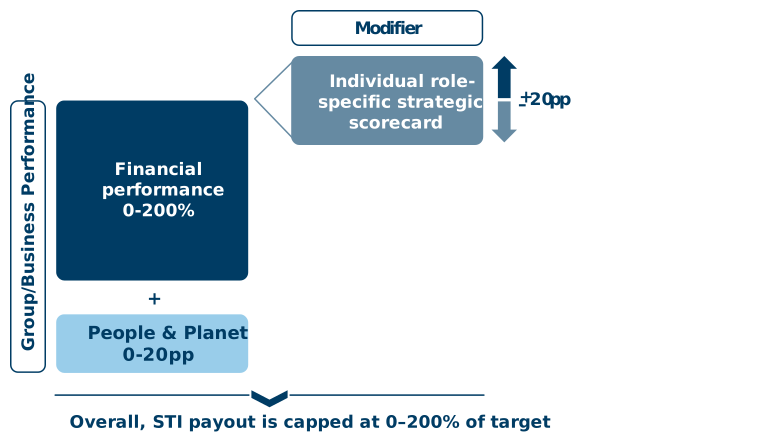
VCC: simplified framework and re-naming to STIP | To enhance clarity, foster collaboration, and strengthen accountability, the Board has decided to simplify the VCC design. Going forward, financial and non-financial performance will be assessed at the group and business level and complemented by individual role-specific strategic scorecards. Financial KPIs, aligned with the company’s core strategic priorities as communicated to investors (Sales Growth and Core EBIT), will remain the primary driver of the STI. Sustainability objectives will remain a dedicated pillar at the group and business level, covering People and Planet, measured through two dedicated KPIs. Individual role-specific strategic scorecards will reflect relevant non-financial business factors and may adjust the financial outcome by up to ±20 percentage points. The STI payout range will continue to be from 0% to 200%, with a payout cap at 200%. |
Changes for financial year 2026/2027 | Resulting compensation design for 2026/27 | |
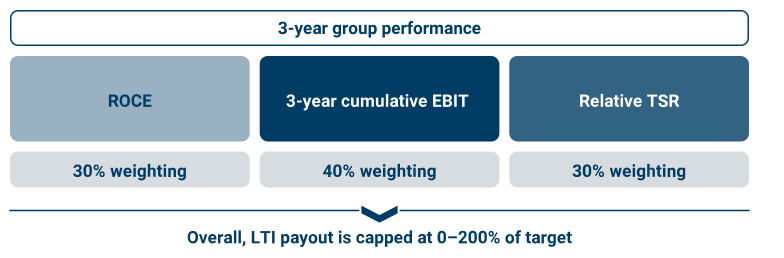
EEAP: new framework design with 100% PSUs, 3 key KPIs and re-naming to LTIP | To further align with prevalent market practice and shareholders’ interests, performance options will be discontinued and fully replaced by PSUs. The grant date will be moved from 1 February to 1 June to better align with the annual strategy review and the reward cycle. PSU vesting will be driven by three KPIs designed to balance management’s delivery of sustainable financial performance with shareholders’ experience of value creation: Cumulative EBIT serves as a measure of sustained profitability and long-term operational performance (40% weighting). Return on Capital Employed (ROCE) to explicitly reflect capital efficiency (30% weighting). Relative TSR, assessed against a tailored Swiss and international peer group, reflects the capital market’s assessment of the company’s performance and its ability to convert internal value creation into shareholder returns (30% weighting). The overall vesting range of 0% to 200% will be retained. PSUs will continue to be subject to a three-year vesting period, followed by a two-year sales restriction period. |
Changes for financial year 2026/2027 | Resulting compensation design for 2026/27 | |
Shareholding requirements: Further alignment with market practice | Following the changes to the LTIP design, the target holding levels and build-up periods under the shareholding requirements for the Group Executives will be reset to align with prevailing market practice. Furthermore, the shareholding requirements for the Board of Directors will also be reset to align with prevailing market practice and to simplify the overall framework. | |
Board compensation: Adjustment of sales restriction period for equity-based fee | As part of the comprehensive review of Sonova’s compensation framework, the sales restriction period for the equity-based Board fee was aligned with prevailing market practice. |
Compensation design for 2025/26 | Compensation design for 2026/27 | |||
Name | VCC | STIP | ||
Performance Objective | Group objectives (Weighting: 30%-75%): Sales, EBITA, FCF and EPS | 2 financial KPIs which comprise the majority of the overall STI structure and which are aligned with Sonova’s core strategic priorities communicated to investors (Sales Growth and Core EBIT) | ||
Business objectives (Weighting: 0%-45%): Sales, Profitability and DWCO | ||||
ESG objectives (Weighting: 10%): Multiple KPIs on corporate and individual level | 2 KPIs addressing employee engagement and planet considerations to complement financial outcomes by up to 20 percentage points | |||
Individual objectives typically weighted at 15% | Individual role-specific scorecards to adjust the financial outcome by ±20 percentage points | |||
Payout range | 0%-200% | 0%-200% | ||
Name | EEAP | LTIP | ||
Instrument | Options and PSUs | PSUs | ||
Grant date | 1 February | 1 June | ||
Performance Objective | Options: Annual ROCE | 3 KPIs covering Cumulative EBIT (40% weighting), ROCE (30% weighting) and relative TSR (30% weighting) measured against a tailored Swiss and international peer group. | ||
PSUs: relative TSR measured against SLI index | ||||
Vesting | Options: 4 equal annual instalments spanning 16 to 52 months | Cliff vesting 3 years post-grant | ||
PSUs: cliff vesting 3 years and 4 months post-grant | ||||
Vesting range | Options: 0%-100% | 0%-200% | ||
PSUs: 0%-200% | ||||
Restriction period | 5 years from grant date | 5 years from grant date | ||
Shareholding requirements for Board | Board Chair: CHF 200,000 | Board Chair: 300% × base fee | ||
Other Board members: CHF 200,000 | Other Board members: 200% × base fee | |||
Build-up period: 80% within 2 months; 100% within 14 months | Build-up period: 5 years | |||
Shareholding requirements for Group Executives | CEO: CHF 1,000,000 | CEO: 300% × annual base salary | ||
Other Group Executives: CHF 200,000 | Other Group Executives: 200% × annual base salary | |||
Build-up period: up to three years and two months | Build-up period: 5 years | |||
Sales restriction period for equity-based Board fee | Board Chair: 5 years and 4 months | 3 years | ||
Other Board members: 4 years and 4 months |