5.2Group Executives compensation framework
As outlined in the introduction, Group Executivesʼ compensation links directly to company strategy and business results, aligning their interests with shareholders. Performance matters – and pay reflects it.
The following table provides an overview of the compensation components of the Group Executives (including the CEO). The ratio of the VCC and the EEAP as a percentage of the fixed base salary (shown in the following table) can vary slightly year-on-year, depending on which component (if any) is adjusted as a result of the compensation review.
Following the compensation review, selective adjustments were made to forward-looking, performance-based variable compensation targets aligned with Group Executivesʼ roles and responsibilities, and linked to external compensation reference points.
Compensation structure 2025/26 Financial Year
Fixed compensation components | Variable compensation components | |||||||||
Fixed base salary1 | Benefits1 | VCC 1 | EEAP1 | |||||||
Purpose | Depends on the market value of the role and the skills, experience, and profile of the incumbent | Establishes level of security in line with local market practice Mandatory and voluntary benefits plans offered by the employer | Rewards performance against key performance indicators (KPIs) at Group and business unit level, plus the achievement of individual objectives | Rewards long-term value creation and reinforces alignment with shareholder interests | ||||||
Vesting Period | n.a. | n.a. | Financial year | Options 16–52 months | PSUs 40 months | |||||
KPIs | n.a. | n.a. | A – Group Sales, EBITA, FCF, EPS B – Business Unit Sales, EBITA, DWCO C – ESG objectives D – Individual objectives | ROCE | rTSR | |||||
Delivery | Cash, regularly | Country specific | Cash | Options | PSUs | |||||
Restriction period | n.a. | n.a. | n.a. | Five years from grant date | ||||||
Cap | n.a. | n.a. | Yes | Yes | ||||||
CEO Ratio in % of fixed base salary: | n.a. | n.a. | Target of fixed base salary: 80% | Target of fixed base salary: 180% | ||||||
Group Executives (excl. CEO) Ratio in % of fixed base salary: | n.a. | n.a. | Target of fixed base salary: up to 70% | Target of fixed base salary: up to 115% | ||||||
EBITA = Earnings Before Interest, Taxes, and Amortization | FCF = Free Cash Flow | EPS = Earnings per Share | DWCO = Days of Working Capital Outstanding | ESG = Environment, Social, and Governance | PSUs = performance share units | ROCE = Return on Capital Employed | rTSR = relative Total Shareholder Return
1Within the framework of the Articles of Association and the maximum aggregate amount of compensation approved by the AGM.
Fixed base salary
Fixed base salary is a payment made in cash in regular instalments. The salary level is based on the scope and complexity of the position, market benchmarks, and the individualʼs profile including skills and experience. Salary progression is contingent on the individualʼs performance, market developments, and the economic environment.
Short-term cash incentive award (Variable Cash Compensation)
Sonovaʼs variable cash compensation (VCC) aligns a significant portion of the Group Executivesʼ compensation to performance in a given financial year. VCC is defined as a percentage of the annual fixed base salary.
How it works: Annually, the Board sets target performance levels for each KPI for the following financial year, based on recommendations of the NCC. The targets are deliberately challenging – generally requiring improvements from the prior financial year on an adjusted basis, in line with ambitious mid- and long-term financial plans. Performance targets are drawn from the strategic plan.
Demanding targets help Sonova deliver best-in-class performance and stay ahead of the market. Payout levels between threshold, target, and maximum are generally calculated by linear interpolation.
Design of the VCC
Performance objectives | Group objectives | Business objectives1 | ESG objectives | Individual objectives | ||||
Purpose | Drive growth ambitions, profitability, margins, operational and capital efficiency | Drive business operational performance | Drive targets of IntACT, Sonova’s ESG strategy | Drive individual performance in line with the company strategy | ||||
KPIs | Sales (in LC) EBITA (in CHF) FCF (in CHF) EPS (in CHF) | Sales Profitability DWCO | Climate change Talent management Other | Initiatives/Projects | ||||
Weighting | CEO/CFO: 75% Other members: 30-75% | CEO/CFO: 0% Other members: 15-45% | CEO: 10% CFO: 10% Other members: 10% | All Group Executives: 15% | ||||
Payout formula | Minimum: 0% Target: 100% Maximum: 250% (Sales) 200% (for all other KPIs) | Minimum: 0% Target: 100% Maximum: 250% (Sales) 200% (for all other KPIs) | Minimum: 0% Target: 100% Maximum: 200% | Minimum: 0% Target: 100% Maximum: 200% | ||||
Maximum payout level (% of target) | 200% for the CEO and other Group Executives | |||||||
EBITA = Earnings Before Interest, Taxes, and Amortization | FCF = Free Cash Flow | EPS = Earnings per Share | DWCO = Days of Working Capital Outstanding
1Not all business objectives apply to all Group Executives.
Ranges of performance objectives for Group Executives | ||||||||||
Performance Objective | CEO/CFO | Other Group Executives1 | Minimum payout (threshold) | Target payout (target) | Maximum payout (cap) | |||||
A – Group objectives | ||||||||||
Sales (in LC) | 20% | 10% – 20% | 0% | 100% | 250% | |||||
EBITA (in CHF) | 0% | 10% – 20% | 200% | |||||||
FCF (in CHF) | 20% | 10% – 20% | ||||||||
EPS (in CHF) | 35% | 0% – 15% | ||||||||
B – Business objectives 2) | ||||||||||
Sales | 0% – 20% | 0% | 100% | 250% | ||||||
Profitability | 15% – 20% | 200% | ||||||||
DWCO | 0% – 5% | |||||||||
C – ESG objectives | ||||||||||
ESG - Climate Change | 2.5% | 0% – 2.5% | 0% | 100% | 200% | |||||
ESG - Talent Management | 2.5% | 0% – 2.5% | 0% | 100% | 200% | |||||
ESG - Other | 5% | 5% – 10% | 0% | 100% | 100% – 200% | |||||
D – Individual | ||||||||||
Initiatives/Projects | 15% | 15% | 0% | 100% | 200% | |||||
Total | 0% | 100% | 200% | |||||||
1In exceptional circumstances, up to 35% (e.g. to support key strategic initiatives and critical roles).
Individual performance is based on the achievement of objectives defined at the beginning of each financial year between the CEO and each Group Executive – and, for the CEO, between the Board and the CEO. For the CEO, individual targets typically include strategy and organizational development, key R&D projects, new product launches, restructuring and performance management initiatives, M&A activities, and operational excellence. For other Group Executives, individual objectives vary based on their role and may include key initiatives and projects in innovation, commercial excellence, customer experience, brand positioning, marketing excellence, product launches, M&A activities, operational excellence (covering supply chain management, procurement process, and inventory management), compliance, organization and team development, the employee value proposition, and succession planning.
In case of significant unforeseen events that could not be reflected in the target-setting process, the Board may adjust performance targets or measurements based on pre-defined guidelines. These adjustments may be triggered by M&A activities above a certain threshold, material currency exchange rate impacts, restructuring costs, and legal, tax, and accounting adjustments.
Long-term equity incentive award (EEAP)
The EEAP drives long-term value creation, aligns the interests of shareholders and Group Executives, and helps retain critical talent at Sonova.
How it works: The EEAP is offered annually to Group Executives. The Board determines individual grant levels – for Group Executives based on CEO recommendations, and for the CEO based on the recommendations from the Board Chair and the NCC. Typically, grants have been made on 1 February each year. Following the compensation framework review and related changes effective for the 2026/27 financial year, future grants will be made on 1 June (see Outlook section for further details on the new LTI design). As a consequence, there was no regular LTI grant in the 2025/26 financial year. An exception applies to one Group Executive who joined the company during the reporting year and was eligible for a grant later in the year under the existing EEAP framework, with all core conditions unchanged (see illustration below).
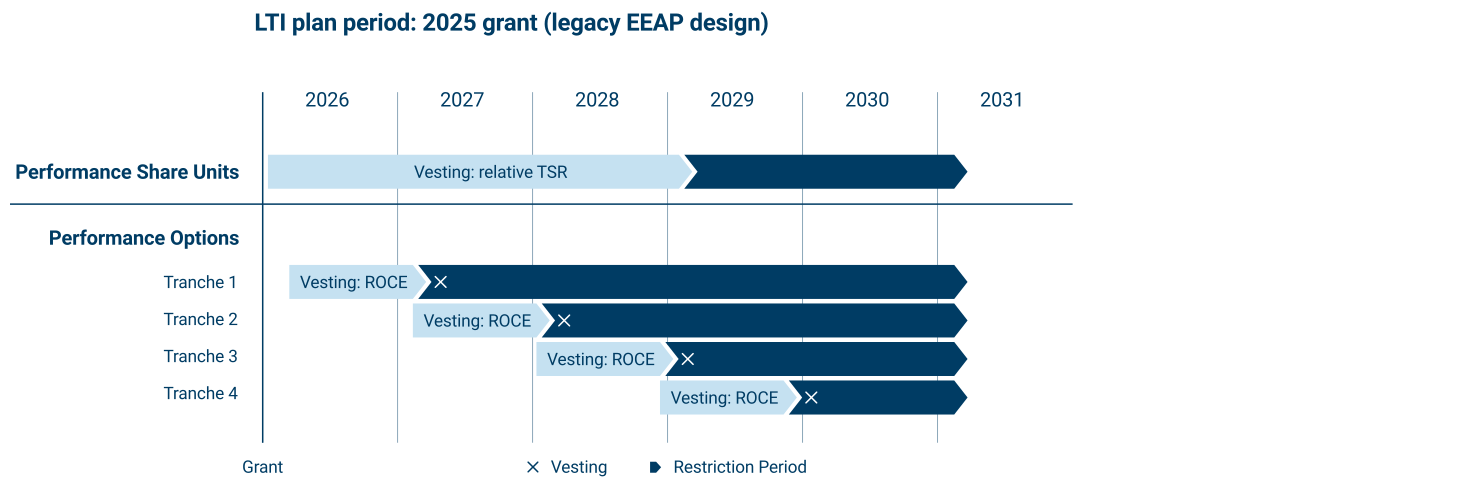
Both performance options and PSUs are subject to a post-vesting restriction period that lasts from the vesting date until the fifth anniversary of the grant date. During this period, EEAP awards cannot be exercised, sold, pledged, assigned, transferred, or otherwise disposed of.
Design of the EEAP
Equity | Performance Options | PSUs | ||
Purpose | Provide for a close alignment with the interests of shareholders in the form of share price appreciation | Foster the company’s ability to outperform the market | ||
Equity Mix | CEO: 62.5% Other Group Executives: 50% | CEO: 37.5% Other Group Executives: 50% | ||
Performance Criteria | ROCE | Sonova’s TSR ranked against SLI constituents | ||
Grant Date | Usually February | Usually February | ||
Fair Value1 | Based on Enhanced American Model valuation (Black-Scholes Model for the impact of the restriction period) | Based on Monte Carlo Model valuation | ||
Exercise/Strike Price | CHF 238.60 (Sonova closing SIX share price on grant date) | n.a. | ||
Vesting Date | The award vests in four equal annual tranches following the grant date | Cliff vesting after three years and four months, following the end of the performance period | ||
Performance vesting | 0%–100% of grant (ROCE)2 Linear interpolation between threshold, target, and cap | Threshold: 25th percentile = 0% payout Target: 50th percentile = 100% payout Cap: 75th percentile = 200% payout Linear interpolation between threshold, target, and cap3 | ||
Maximum Vesting Level (of grant) | 100% | 200% (Capped at 100% if Sonova's absolute TSR is negative) | ||
Restriction Period4 | Five years from the grant date | Five years from the grant date | ||
Exercise Period | After the end of the restriction period until expiry | n.a. | ||
Maturity/Expiry Date | Total 10 years | No maturity/expiry restriction after vesting |
Clear rules apply in case of the exclusion of a peer company from the SLI index: In the case that a company in the comparison group is excluded from the SLI but is still actively trading, it is retained in the comparison group. Companies that undergo a merger during the performance period and are fully delisted are treated as “inactive” (i.e. are removed from the comparison group). The SLI was selected to compare Sonova’s performance to other Swiss listed companies with comparable complexity and geographic footprint, providing a relevant and challenging benchmark for Sonovaʼs value creation. A performance period slightly shorter than the vesting period provides for sufficient time to measure the performance achievement and receive approval of the calculation prior to vesting. For the performance period, only companies which have been a constituent in the Swiss Leader Index (SLI) throughout the entire performance period are considered. For the vesting in June 2026, the comparison group included the following companies: Alcon AG, ABB Ltd., Compagnie Financière Richemont SA, Geberit AG, Givaudan SA, Julius Baer Gruppe AG, Kuehne & Nagel International AG, Holcim Ltd, Logitech International S.A., Lonza Group AG, Nestle S.A., Novartis AG, Partners Group Holding AG, Roche Holding Ltd, Schindler Holding AG, SGS SA, Sika AG, Straumann Holding AG, Swiss Life Holding AG, Swiss Re AG, Swisscom AG, UBS Group AG, VAT Group AG and Zurich Insurance Group Ltd.
1Additional information on the fair value calculations are available in Note 7.4 to the consolidated financial statements. For performance options, the re-pricing of any out-of-the-money options granted under the EEAP is prohibited.
2The Board generally determines the target level of performance at which the options will vest in full, and a minimum performance threshold below which there is no vesting. There is no over-achievement possible. The ambition is to continuously improve ROCE over time, in line with strategic planning.
3Sonova’s remuneration philosophy is to pay for performance and to maintain a reasonable risk profile for the incentive plans. Therefore, a partial payout is possible if the performance exceeds the first quartile of the peer group. Symmetrically, the payout is capped in case of outstanding performance. This mechanism aims to provide for a robust balance.
4The five-year restriction period applies to all PSUs granted in February 2020 and onwards. During this period, even after the vesting date, PSUs and underlying shares cannot be sold, pledged, assigned, transferred, or otherwise disposed of.
Termination of employment under the EEAP
In the event of termination of employment, unvested awards (PSUs, options, and outstanding restricted share units – RSUs – from previous programs) are generally forfeited. Any applicable restriction periods for grants from 2020 onwards continue to apply, unless noted in the following table. Vested options must be exercised within a period of three months (commencing with the expiry of the restriction period or, if the restriction period has already expired, on the date of termination).
EEAP termination provisions | ||||||||||
Unvested PSUs | Vested PSUs | Unvested Options | Vested Options | Unvested RSUs | ||||||
Death, disability | Regular vesting | Immediate unblocking | Immediate vesting | Immediate unblocking, 12-month exercise period | Immediate vesting | |||||
Retirement | Regular vesting pro rata (if qualified retirement condition is met) or forfeiture (other retirement cases) | Regular restriction | Regular vesting if vesting date within year of termination, otherwise forfeiture | 12-month exercise period after the end of the restriction period | Regular vesting if vesting date within year of termination, otherwise forfeiture | |||||
Termination for cause | Forfeiture | Forfeiture | Forfeiture | Forfeiture | Forfeiture | |||||
Termination due to change of control (double trigger) | Immediate vesting pro rata (performance achievement) | Immediate unblocking | Immediate vesting pro rata (performance achievement) | Immediate unblocking | Immediate vesting pro rata | |||||
Disclosure of targets
Internal financial targets and individual objectives are generally considered sensitive information as they provide insight into confidential strategic goals. However, to further increase transparency of our incentive plans without disclosing commercially sensitive information, an ex-post disclosure of the Group (financial and ESG) targets under the VCC, and EEAP targets of the tranches vesting based on the reported performance year is provided.
Sonova share ownership guidelines
To further align Group Executives with shareholdersʼ interests, our share ownership guidelines require the Group Executives to hold a minimum monetary value in Sonova shares:
- CEO: CHF 1,000,000
- Other Group Executives: CHF 200,000
Timeline for compliance: Group Executives have three years and two months after receiving their first grant to meet the full requirement, with interim milestones:
- 12.5% of requirement: Within one year and two months
- 25% of requirement: Within two years and two months
- 100% of requirement: Within three years and two months.
Only fully vested shares and open market purchases count towards the requirement. The NCC reviews compliance annually as of March 31.
Benefits and pension plan
Given the various locations of the Group Executives, they participate in benefit plans available in their country of employment. Benefits primarily consist of retirement, insurance, and healthcare plans designed to provide reasonable protection for employees and their dependents – covering retirement income, healthcare, and the risk of disability or death.
Swiss-based Group Executives: Sonova maintains defined-contribution plans under Swiss occupational pension regulations. Group Executivesʼ Swiss employment contracts are eligible for the same benefits as all other employees in Switzerland and are subject to mandatory employer social security contributions (AHV/ALV).
International Group Executives: Group Executives with foreign employment contracts receive benefits aligned with local country practices.
Additional benefits: The CEO and select Group Executives receive a flat-rate cash car allowance and an expense allowance, in line with Swiss management expense regulations, which is approved by the Swiss tax authorities. International Group Executives may also receive relocation support, temporary housing, travel benefits, and tax advice, consistent with established policies and practices.
Disclosure: All benefits and company contributions are disclosed in this Compensation Report in compliance with Sonovaʼs reporting obligations. Other benefits are included in the compensation tables at fair value.
Employment terms and conditions
Forfeiture Provision: All Group Executivesʼ employment agreements include a forfeiture provision requiring repayment of any compensation paid or granted prior to the AGM should shareholders not approve the proposed aggregate compensation.
Contract terms and non-competition clauses: All Group Executives have permanent employment agreements with a maximum notice period of six months – twelve months for the CEO. Their employment agreements may include non-competition arrangements for up to twelve months.
Sonova does not grant contractual severance payments, make advance payments, or grant loans to Group Executives. There are no change of control provisions except those highlighted in the EEAP termination provisions.
Claw-back
Clawback and malus provisions apply to both the VCC and EEAP awards, allowing Sonova to reduce (malus) or reclaim (clawback) compensation, partially or fully, in specific circumstances. These provisions are triggered by accounting or financial restatements due to non-compliance with Swiss financial reporting requirements at the time of disclosure, fraud, or violation of law. These provisions apply for three years following the financial year to which the VCC payment or EEAP grant/vesting relates. The five-year restriction period under the EEAP provides an additional safeguard in the event of an accounting or financial restatement due to non-compliance with Swiss financial reporting requirements at the time of disclosure.