Environmental Information
_width-1240.jpeg)
_width-1240.jpeg)
The following topics are covered in the environmental information chapter, with Climate change identified as the material environmental topic:
Climate change
Strategy, governance, and IROs
At Sonova, we recognize our responsibility to address climate change and acknowledge the need to achieve net zero emissions by 2050. Rising temperatures and extreme weather pose risks not only to our business but also to society and the environment. Sonovaʼs Board of Directors has ultimate oversight and responsibility for all sustainability topics, including climate change. The Board of Directors and its committees receive climate change performance metric updates regularly. At Group Executive Committee level, responsibility for environmental sustainability is assigned to the Chief Operations Officer, who monitors scope 1–3 greenhouse gas (GHG) emissions regularly. Within each region, dedicated environmental leaders are responsible for driving scope 1 and 2 emission reductions as well as implementing energy efficiency measures with local Group Companies. This governance structure ensures global coherence in our approach toward GHG emissions reduction while allowing for targeted ad hoc reduction activities relevant to differing local contexts. For scope 3 reductions, dedicated cross-functional teams work on GHG emission reductions to accelerate Group-wide climate action. The topic of climate change is defined as climate change mitigation, climate change adaptation, and energy use, and is relevant to Sonova along the entire value chain.
Material impacts, risks, and opportunities related to climate change:
IRO | Occurrence | Expected time horizon | ||
Negative impact: Greenhouse gas emissions Greenhouse gas emissions from energy used for own operations and production by suppliers contribute to climate change, leading to further negative environmental impacts. | Entire value chain | Increase in medium- to long-term |
Our climate strategy addresses both mitigation of the causes of climate change and resilience to its effects, combining effective near-term actions to secure important long-term results. It is underlined by our ambitious near-term Science Based Target (SBT), which was approved in 2023 by the Science Based Targets initiative (SBTi). Our goals are to decrease our combined absolute scope 1 and 2 (market-based) emissions by 78.3% and our scope 3 emissions by 32.5% by financial year 2032/33 versus our 2019/20 financial year baseline. To achieve GHG emission reductions, Sonovaʼs overall climate mitigation approach encompasses four types of actions:
- Measure emissions and continuously improve data quality
- Avoid emissions by progressively adopting low-impact solutions
- Replace energy sources with renewable ones
- Engage and collaborate with partners along our value chain to reduce our GHG emissions
Before each new financial year, climate mitigation initiatives inform budget planning processes. For Sonova to achieve the required GHG reductions within our own operations, we need to keep a strong focus on securing 100% renewable energy to power all our sites and electric vehicles (EVs). In addition, Sonova aims to accelerate the transition towards a lower carbon car fleet, by further increasing the ratio of fully electric vehicles and more efficient vehicles. To further reduce operational scope 1 emissions, we will maintain our focus on the energy efficiency of our Retail store network and further electrify our heating supplies.
As part of our commitment to reduce our scope 3 emissions, we will further engage with suppliers and encourage critical partners to align with our decarbonization goals. We also seek to decrease our packaging weight and volume and optimize our supply chain network to shorten distribution distances. Additionally, we are committed to exploring lower-impact materials while embracing circular economy principles, such as designing for repair, dismantling, refurbishing and service.
To strengthen our resilience, we have been identifying climate-related risks and opportunities through structured assessments since the 2021/22 financial year. These cover the nine markets most relevant to Sonova in terms of operational footprint, store network, and sales, providing insights into short- (2025), medium- (2030), and long-term (2050) risks. While the 2025 short-term horizon was chosen to align with Sonovaʼs short-term risk horizon in the first assessment completed in 2021/22, 2030 is used as a proxy for our near-term Science Based Target. The long-term time horizon aligns with the broadly acknowledged need to achieve net zero emissions by 2050 to keep global warming well below 1.5°C as outlined by the Intergovernmental Panel on Climate Change (IPCC). We assess the potential impact on Sonovaʼs business and resilience using qualitative and quantitative climate-related scenario analyses:
- A high-mitigation, i.e., 1.5°C and below 2°C warming scenario to assess risks related to the transition to a low-carbon future.
- A business-as-usual, i.e., 4°C warming scenario to capture the physical risks associated with the intensification of widespread climate hazards.
These insights are integrated into Sonovaʼs broader strategic enterprise risk management framework alongside other business risks. Based on internal interviews, we identified seven physical risks, four transition risks, and two transition opportunities, totaling thirteen potential climate-related risks and opportunities. Transition risks and opportunities were identified focusing on policy, legal, technology, market, and reputation factors. Next, we conducted a climate analysis using the Representative Concentration Pathway (RCP) 8.5 scenario to project changes in risks and opportunities through 2030 and 2050. We evaluated transition risks and opportunities for short-, medium-, and long-term using various scenarios, including IEA STEPS, which projects a temperature increase of approximately 3°C by 2100, IEA SDS, which predicts global warming to be 1.75°C, and IEA NZE net zero by 2050 scenario. Risks and opportunities were rated qualitatively based on Sonovaʼs footprint and likelihood of occurrence.
Generic country-level analysis of physical and transition risks and opportunities1
Risk/opportunity | Category | Type | AU | BR | CA | CH | CN | DE | UK | US | VN | |||||||||||
Episodes of higher temperatures | Physical risk | Acute | N/A | N/A | Very high | Very high | N/A | Very high | Very high | Very high | N/A | |||||||||||
Extreme cold | Physical risk | Acute | N/A | N/A | Low | Low | N/A | Low | Low | Low | N/A | |||||||||||
Heavy precipitation and flooding | Physical risk | Acute | Moderate | Moderate | N/A | N/A | High | N/A | N/A | N/A | Very high | |||||||||||
Heavy winds and storms | Physical risk | Acute | N/A | N/A | N/A | Low | Low | Low | Low | High | N/A | |||||||||||
Tropical cyclones | Physical risk | Acute | High | N/A | N/A | N/A | Low | N/A | N/A | N/A | Low | |||||||||||
Wildfires | Physical risk | Acute | High | N/A | N/A | N/A | N/A | N/A | N/A | Very high | N/A | |||||||||||
Sea level rise and coastal flooding | Physical risk | Chronic | High | High | N/A | N/A | N/A | N/A | N/A | N/A | Very high | |||||||||||
Carbon pricing schemes | Transition risk | Policy & legal | Very high | Very high | N/A | Low | N/A | Low | Low | N/A | N/A | |||||||||||
Net zero retrofit requirements | Transition risk | Policy & legal | Very high | N/A | Low | Low | Low | Low | Low | Low | Low | |||||||||||
Scope 3 reduction challenges | Transition risk | Policy | N/A | N/A | N/A | N/A | High | Low | N/A | N/A | N/A | |||||||||||
Increase in airfares | Transition risk | Policy | N/A | N/A | N/A | High | N/A | High | High | N/A | N/A | |||||||||||
Energy savings due to net zero retrofits | Transition opportunity | Market | Very high | N/A | Low | High | Moderate | Low | Low | High | Low | |||||||||||
Electrification of transportation sector | Transition opportunity | Market | Very high | N/A | N/A | N/A | N/A | N/A | N/A | N/A | N/A |
Country abbreviations: AU: Australia; BR: Brazil; CA: Canada; CH: Switzerland; CN: China; DE: Germany; UK: United Kingdom; US: United States of America; VN: Vietnam
1)The physical risks are classified based on the projected changes until 2050 vs. baseline: low = below 10%, moderate = 10-20%, high = 20-30%, very high = above 30%. The baseline period 1976 – 2005 was derived from the coupled model intercomparison project phase 5 (CMIP5) data set. Where the supporting literature used different baselines or different future timeframes, we adjusted the baselines and/or the relative change accordingly.
The assessment of transition risks revealed low risks overall, except for challenges in reducing scope 3 emissions from suppliers in China, potential increases in operating costs due to stricter aviation policies, and risks from carbon pricing schemes in Australia and Brazil.
To assess how physical climate-related risks could impact Sonovaʼs long-term operations (2050), we conducted a site-level assessment of four very high-scoring risks from our country-level assessment. The findings are summarized in the table below. Sonovaʼs omnichannel strategy, which emphasizes online sales and service, can help mitigate some identified risks and enhance resilience.
TCFD – Summary of Sonova-specific site-level analysis1
Potential risk | Country | Potential threat | ||
Episodes of higher temperatures | United States, United Kingdom, Germany, Canada, Switzerland | The frequency and duration of higher temperatures are expected to rise, particularly in the southern and eastern U.S., leading to higher cooling costs and greater heat stress for employees and consumers. Since elderly individuals, who are most prone to hearing loss, are also highly vulnerable to heat stress, they may avoid stores, impacting sales. | ||
Wildfires | United States | Rising average and peak temperatures during wildfire season will heighten wildfire risks, which may impact our California production site. | ||
Heavy precipitation and flooding | Vietnam | Heavy precipitation in the Ho Chi Minh City region is expected to rise significantly, potentially impacting our supply chain and operations center through flash and sustained flooding. | ||
Sea level rise and coastal flooding | Vietnam | As our operations center in Vietnam is located far inland, the projected sea level rise and coastal flooding is expected to pose no substantial risk. |
1)For this assessment, we used various datasets derived from General Circulation Model (GCM) and simulations conducted under the Coupled Model Intercomparison Project, Phase 5 (CMIP5).
We quantified the financial impact of two risks: increased heavy precipitation and flooding near our operations in Vietnam and China, and rising air-transportation costs due to carbon policies. Our assessment indicated that flood risk to our operations is not expected to increase, as local teams have precautions in place. We then focused on critical suppliers, finding that four supplier locations are at risk of river flooding and two of coastal flooding. The financial impact was calculated based on potential operational downtime, supply shortages, and revenue loss. Overall, the assessment showed low risk today, in 2030, and in 2050 under both 2°C and 4°C scenarios.
We assessed the potential financial impact of rising carbon prices on air transportation costs in Switzerland, Germany, and the UK. The analysis indicates that air freight presents a higher risk exposure than business travel; however, the overall financial risk is assessed as low in both 2030 and 2050. Achieving our current science‑based targets could reduce potential carbon‑related costs by approximately 70%.
Policies and actions
Climate action has been at the top of Sonovaʼs environmental agenda for many years along the entire value chain and is governed by several policies. The Code of Conduct focuses on our general climate change commitment for our own employees and business partners. The Corporate Environmental Sustainability Policy principles include continuous monitoring and improvement of our environmental objectives and performance across the Group. In addition, we train our employees on the policy while raising awareness on environmental topics and consideration of environmental sustainability in business decisions and activities, facility construction, and modifications. The Supplier Code of Conduct covers the upstream value chain and climate-related aspects.
In the 2025/26 financial year, we have continued to install LED lighting across our facilities, optimized HVAC equipment, switched from fossil fuel heating to electric heating (e.g., heat-pumps), installed EV chargers, and improved building management systems to increase our energy efficiency and reduce scope 1 and 2 emissions. We have continued to increase the number of EVs in our fleet and updated our car policy to further incentivize their uptake. We also implemented energy reduction initiatives across 12 of our largest retail markets, focusing on simple user-behavior measures such as temperature settings and out-of-hours switch-off.
To reduce our scope 3 emissions, we implemented a range of initiatives during the 2025/26 financial year. Our supplier engagement efforts intensified and sustainability criteria were further embedded in our procurement processes, including incorporating sustainability performance as a scored criterion in selected vendor assessments. The increasing use of primary supplier carbon data and validated Product Carbon Footprints (PCFs) is also improving the accuracy of Sonovaʼs scope 3 reporting, enabling the recognition of emissions reductions delivered through supplier decarbonization initiatives. For more details on supplier initiatives refer to Supplier relations. We further strengthened the integration of GHG emissions reduction and broader sustainability considerations into product development in our Hearing Instruments and Consumer Hearing businesses. Further initiatives focused on optimizing our supply chain network, with an increased emphasis on shipping materials and products via ground and sea freight to reduce emissions. During the 2024/25 financial year we started piloting an internal carbon price of CHF 100 per tCO2e, applying it to material and supplier selection as well as project evaluations to drive lower-carbon decision-making. In the reporting period, we considered such carbon price on a project-by-project basis.
Performance metrics and targets
Energy
Sonovaʼs total energy consumption decreased by 2.5% in the 2025/26 financial year compared with the previous year, corresponding to a 1.0% reduction per full‑time equivalent (FTE). The decrease was primarily driven by lower fuel consumption from the company car fleet, as well as reduced electricity use in offices and Retail locations following footprint consolidation and milder weather conditions.
Energy intensity
Data externally assured (limited assurance)
Sales in CHF million, MWh and MWh/FTE1 | ||||||||
2025/26 vs PY (%) | 2025/26 | 2024/25 | 2023/24 | |||||
Sales | 3,839.1 | 3,865.4 | 3,626.9 | |||||
Total energy consumption | (2.5%) | 107,576 | 110,363 | 111,488 | ||||
Energy intensity relative to sales | (1.9%) | 28.0 | 28.6 | 30.7 | ||||
Energy intensity relative to FTE | (1.0%) | 5.9 | 6.0 | 6.3 |
1)For definition, methodology, data, and restatements, see Sustainability note 1 - Climate change.
Renewable energy accounted for 58.7% of Sonovaʼs total energy consumption in the 2025/26 financial year, broadly unchanged compared to 2024/25. During the reporting period, electricity consumption continued to be covered entirely by renewable sources.
Sonova follows a three‑step approach to sourcing renewable electricity. First, we invest in onsite renewable generation: in 2025/26, self‑generated electricity from onsite photovoltaic installations represented 1.8% of total energy consumption. Where onsite generation is not feasible, Group Companies are encouraged to source certified renewable electricity locally. As a result, 29.5% of total purchased electricity was sourced through bundled Energy Attribute Certificates (EACs) and 3.9% through Power Purchase Agreements (PPAs).
For locations where renewable electricity is not yet available, Sonova purchases unbundled Energy Attribute Certificates, which covered the remaining 66.6% of total procured electricity consumption.
Energy mix
Data externally assured (limited assurance)
MWh | ||||||||
2025/26 vs PY (%) | 2025/26 | 2024/25 | 2023/242 | |||||
Total energy consumption1 | (2.5%) | 107,576 | 110,363 | 111,488 | ||||
Total energy consumption from purchased fuels | (0.1%) | 47,382 | 47,450 | 50,373 | ||||
Total energy consumption from purchased non-renewable fuels | (2.4%) | 44,445 | 45,526 | 48,681 | ||||
Crude oil and petroleum products | 20,869 | 23,070 | 23,280 | |||||
Natural gas | 18,143 | 17,742 | 21,343 | |||||
Liquefied petroleum gas | 359 | 218 | 0 | |||||
District heating | 5,074 | 4,497 | 4,058 | |||||
Total energy consumption from purchased renewable fuels | 52.7% | 2,937 | 1,924 | 1,691 | ||||
Biomass / biogas | 2,937 | 1,924 | 1,691 | |||||
Total energy consumption from purchased electricity | (4.4%) | 58,294 | 60,995 | 59,073 | ||||
Total energy consumption from purchased non-renewable electricity | 0 | 0 | 0 | |||||
Total energy consumption from purchased renewable electricity | 58,294 | 60,995 | 59,073 | |||||
Solar | 7,625 | 4,667 | ||||||
Hydro | 7,296 | 28,208 | ||||||
Wind | 3,490 | 5,467 | ||||||
Mixed sources / unknown | 39,883 | 22,653 | 59,073 | |||||
Total energy consumption from self-generated renewable electricity | (0.9%) | 1,900 | 1,918 | 2,043 | ||||
Total energy consumption from non-renewable sources | (2.4%) | 44,445 | 45,526 | 48,681 | ||||
Total energy consumption from renewable sources | (2.6%) | 63,131 | 64,837 | 62,807 | ||||
Share of renewable energy | 58.7% | 58.7% | 56.3% | |||||
Share of renewable electricity procurement methods | ||||||||
Power purchasing agreement | 2,255 | 2,717 | ||||||
Total bundled energy attribute certificates | 17,215 | 20,287 | ||||||
Total unbundled energy attribute certificates | 38,824 | 37,991 |
1)For definition, methodology, data, and restatements see Sustainability note 1 - Climate change. No energy is sourced from nuclear, coal, nor from geothermal, hydrogen, or other renewable and non-renewable sources not listed in the table.
2)Breakdown of renewable sources and certified renewable electricity procurement methods is not available for the 2023/24 financial year.
Greenhouse gas (GHG) emissions
Sonova classifies GHG emissions into the following categories:
- Scope 1: direct GHG emissions deriving from the combustion of fossil fuels related to company vehicles, stationary combustion (e.g., heating), and fugitive emissions (e.g., from refrigerants)
- Scope 2: indirect GHG emissions from sources such as electricity or district heating
- Scope 3: GHG emissions that arise from our value chain
Key ESG targets:
We reduce scope 1 and 2 greenhouse gas emissions by 78.3% vs. 2019/20 by 2032/33.*
We reduce scope 3 greenhouse gas emissions by 32.5% vs. 2019/20 by 2032/33.*
* Approved by the Science Based Targets initiative (SBTi) in 2023. The target boundary includes biogenic land-related emissions and removals from bioenergy feedstocks.
Our near-term science-based targets guide our GHG emissions reduction efforts. During the 2025/26 financial year, our scope 1 and 2 emissions decreased by 68.7% compared to 2019/20 and increased by 1.6% compared to 2024/25. Scope 3 decreased by 14.7% compared to 2019/20, and increased by 0.7% compared to 2024/25. Our total scope 1–3 GHG emissions in 2025/26 increased by 0.7% compared to the previous year, while representing a 20.5% decrease versus 2019/20.
GHG emissions – Scope 1–3
Data externally assured (limited assurance)
Metric tons CO2e1 | ||||||||||||||
2025/26 | 2024/25 | 2023/24 | ... | 2019/20 (SBTi target baseline) | 2025/26 vs PY (%) | 2025/26 vs b'line (%) | ||||||||
Scope 12 | 9,999 | 9,907 | 10,430 | 12,828 | 0.9% | (22.1%) | ||||||||
Mobile combustion | 4,710 | 5,268 | 5,426 | 6,361 | (10.6%) | |||||||||
Stationary combustion | 3,979 | 3,803 | 4,443 | 6,058 | 4.6% | |||||||||
Refrigerants | 1,311 | 836 | 561 | 409 | 56.8% | |||||||||
Scope 2 (market-based) | 889 | 808 | 729 | 21,919 | 10.1% | (95.9%) | ||||||||
Scope 1-2 (market-based) | 10,888 | 10,715 | 11,159 | 34,747 | 1.6% | (68.7%) | ||||||||
Scope 2 (location-based) | 18,275 | 18,712 | 19,594 | 19,497 | (2.3%) | |||||||||
Scope 1-2 (location-based) | 28,274 | 28,619 | 30,024 | 32,325 | (1.2%) | |||||||||
Scope 3 | 247,040 | 245,419 | 223,935 | 289,735 | 0.7% | (14.7%) | ||||||||
Category 1: Purchased goods and services | 128,118 | 124,069 | 120,659 | 161,589 | 3.3% | |||||||||
Category 2: Capital goods | 3,298 | 2,925 | 2,605 | 3,073 | 12.8% | |||||||||
Category 3: Fuel- and energy-related activities | 9,603 | 9,922 | 8,098 | 8,076 | (3.2%) | |||||||||
Categories 4 and 9: Upstream and downstream transportation and distribution3 | 66,063 | 64,898 | 51,098 | 57,235 | 1.8% | |||||||||
Category 5: Waste generated in operations | 555 | 555 | 558 | 1,246 | 0.0% | |||||||||
Category 6: Business travel | 13,307 | 14,246 | 12,943 | 23,940 | (6.6%) | |||||||||
Category 7: Employee commuting | 18,830 | 21,780 | 21,079 | 26,986 | (13.5%) | |||||||||
Category 8: Upstream leased assets | 471 | 554 | 584 | 1,419 | (15.1%) | |||||||||
Category 11: Use of sold products | 4,166 | 3,873 | 3,686 | 4,026 | 7.6% | |||||||||
Category 12: End-of-life of sold products | 2,216 | 2,232 | 2,274 | 2,058 | (0.7%) | |||||||||
Category 15: Investments | 413 | 364 | 353 | 87 | 13.5% | |||||||||
Total scope 1-34 | 257,928 | 256,133 | 235,094 | 324,482 | 0.7% | (20.5%) | ||||||||
Biogenic emissions (out-of-scope)5 | 585 | 383 | 337 | 0 | 52.7% |
1)For definition, methodology, data and emission factor sources, and restatements, see Sustainability note 1 - Climate change. Sonova does not have operational control in investees, therefore our share of GHG emissions related to those are reflected in scope 3, category 15: Investments.
2)None of Sonova's scope 1 emissions are from regulated emission trading schemes. Includes N2O and CH4 emissions from biogenic sources.
3)Financial years 2025/26 and 2024/25 are not methodologically comparable to previous years. Reported figures for financial year 2023/24 and earlier remain the best possible estimates and are therefore considered comparable for reporting purposes.
4)Calculated considering scope 2 (market-based) emissions.
5) Biogenic CO2 emissions are separately disclosed as out-of-scope emissions in accordance with the GHG Protocol. The only source of these emissions is biogas consumption for stationary combustion.
Total GHG emissions 2019/20 – 2025/26
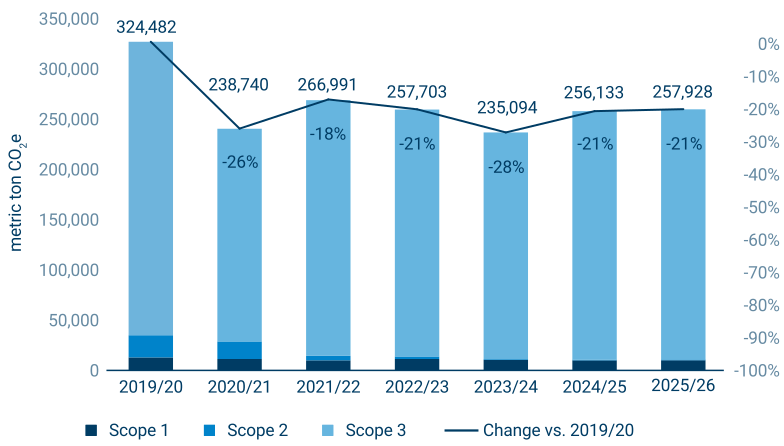
Scope 1 and 2 GHG emissions
Scope 1 emissions increased by 0.9% compared to the 2024/25 financial year, driven primarily by refrigerant gas usage associated with cyclical maintenance activities. This impact was largely offset by the 10.6% emissions reduction of Sonovaʼs car fleet, following the progressive shift to electric and hybrid vehicles. Meanwhile, scope 2 emissions increased by 10.1%, reflecting the increased use of district heating in the reporting year, especially in our Retail stores. Because of our renewable electricity sourcing efforts, Scope 2 emissions have been reduced by 95.9% compared to our SBTi baseline, with district heating being the only remaining source of market-based scope 2 emissions.
Scope 3 GHG emissions
Our value chain accounts for more than 95% of our total GHG emissions, where purchased goods and services, transport and distribution, employee commuting, and business travel represent more than 90% of scope 3 emissions. Maintaining a strong focus on reducing scope 3 emissions therefore remains critical for Sonova. In the 2025/26 financial year, scope 3 emissions increased by 0.7% compared with 2024/25. In the context of continued business growth, largely stable emissions reflect ongoing efforts in our decarbonization journey.
The largest source of Sonovaʼs GHG emissions is the procurement of direct and indirect materials and services, which accounts for 51.9% of scope 3 emissions in the 2025/26 financial year. Category 1 emissions rose by 3.3% compared to the 2024/25 financial year, due to the increase in indirect services expenses. Several initiatives continue our pursuit to lower the GHG emissions intensity of our products and components. Sonovaʼs GHG emissions from transport and distribution increased only by 1.8% compared to the 2024/25 financial year, despite a more significant increase in shipping volumes (+3.7% shipped weight). In 2025/26 financial year we have initiated projects aimed at increasing shipments from air to sea and ground freight. This effort simultaneously supports lower emissions, shorter transportation distances, and greater supply chain resilience.
Air travel represents 98% of Category 6 business travel emissions, while car allowances represent the remaining 2%. In the 2025/26 financial year, overall business travel emissions decreased by 6.6% compared to the previous year and by 44.4% compared to the pre-COVID level of 2019/20. Sonovaʼs GHG emissions from employee commuting also decreased by 13.5% compared to 2024/25, as a result of a substantially lower CO2 intensive mix of means of transport used by Sonova employees during the financial year and slight decrease in FTEs in specific sites.
GHG emission intensity
Data externally assured (limited assurance)
Metric tons CO2e/sales in CHF million1 | ||||||||
2025/26 vs PY (%) | 2025/26 | 2024/25 | 2023/24 | |||||
Sales2 | 3,839.1 | 3,865.4 | 3,626.9 | |||||
Scope 1 | 1.6% | 2.6 | 2.6 | 2.9 | ||||
Scope 2 (market-based) | 10.9% | 0.2 | 0.2 | 0.2 | ||||
Scope 2 (location-based) | (1.7%) | 4.8 | 4.8 | 5.4 | ||||
Scope 1-2 (market-based) | 2.3% | 2.8 | 2.8 | 3.1 | ||||
Scope 1-2 (location-based) | (0.5%) | 7.4 | 7.4 | 8.3 | ||||
Scope 3 | 1.4% | 64.3 | 63.5 | 61.7 | ||||
Scope 1-33 | 1.4% | 67.2 | 66.3 | 64.8 |
1)For definition, methodology, data and emission factor sources, and restatements, see Sustainability note 1 - Climate change.
2)For total sales (incl. Discontinued operations) refer to financial report 2025/26, 5 year key figures and 6.3 Discontinued operations.
3)Calculated considering scope 2 (market-based) emissions.
As part of Sonovaʼs approach to maintaining carbon‑neutral operations, carbon credits are purchased to offset remaining scope 1 and scope 2 emissions. Contractual agreements in place until the end of the 2025/26 financial year supported three projects generating carbon credits: hydropower in China, solar power in Vietnam, and forest protection in the Brazilian Amazon. All projects are certified under either the Gold Standard or the Verified Carbon Standard (VCS).
The carbon credits are used exclusively for offsetting purposes and are not counted toward Sonovaʼs greenhouse gas (GHG) reduction targets. As of the 2025/26 financial year, Sonova has not used or invested in carbon capture and storage (CCS) or direct CO2 removal (CDR) solutions.
Carbon credits
Data externally assured (limited assurance)
Metric tons CO2e avoided outside of Sonova's value chain1 | ||||
2025/26 | % of total | |||
Total carbon credits cancelled | 10,888 | |||
Gold Standard | 1,479 | 14% | ||
VCS (Verified Carbon Standard) | 9,409 | 86% | ||
Future cancellations | ||||
Total future carbon credits cancellation based on contractual agreements 2 | 0 |
1)None of the projects are located in the EU. None of the projects qualify as a corresponding adjustment under Article 6 of the Paris Agreement.
2)Future contract agreements for carbon credit offsets are under discussion and will support Sonova scope 1 and 2 carbon neutrality endeavors as in previous years.
Circular economy
Sonova supports the transition to a circular economy by reducing the extraction and use of natural resources and by addressing product end‑of‑life management.
During the 2025/26 financial year, we advanced the embedding of eco-design principles within our Hearing Instruments and Consumer Hearing product development and innovation processes, increasing cross-functional efforts towards circularity by reducing packaging waste, enhancing product reliability and durability, and optimizing after-sales service.
Packaging and distribution
Key ESG target:
We reduce packaging material weight by 20% vs. 2023/24 by 2026/27 for our Hearing Instruments business.
In the 2025/26 financial year, Sonova reduced packaging material in the Hearing Instruments business by 4.9% compared with the 2023/24 baseline and by 14.8% year‑on‑year. These reductions were driven by cross‑functional initiatives focused on packaging optimization, including the replacement of components with lighter and lower‑carbon alternatives and improvements to overall packaging architecture.
Solutions piloted in the previous year were scaled across multiple brands and geographies during the reporting period. In parallel, engagement with key accounts was initiated to support a more coordinated approach to reducing packaging waste, raise awareness, and strengthen collaboration with customers. In addition, a streamlined packaging concept—designed to reduce material weight by minimizing layers and simplifying unpacking at the point of sale—is currently being implemented.
Packaging weight (Hearing Instruments business)
Data externally assured (limited assurance)
Metric tons1 | ||||||
2025/26 | 2024/25 | 2023/24 | ||||
Packaging weight | 1,185 | 1,391 | 1,246 | |||
Packaging weight reduction vs baseline 2023/24 | (4.9%) | 11.6% |
1)For definition, methodology, data and restatements see Sustainability note 2 - Other environmental topics.
We also prioritize circularity initiatives in our Consumer Hearing business packaging. In the 2025/26 financial year, all newly launched products featured paper-based plastic-free packaging and plant-based ink: 19.6% of Consumer Hearing products and spare parts sold in the reporting period featured plastic-free packaging.
Product use, repair, and refurbishment
Service and repair considerations are embedded in the development process for Sonovaʼs hearing instruments. A range of initiatives has been implemented to extend the lifecycle of our products and components, such as optimizing spare parts usage for electronic modules, extending repair services, testing used devices, and enhancing reliability. Improving product reliability delivers multiple environmental benefits, such as reduced material demand for replacements, lower transportation volumes to service and repair centers, and fewer customer journeys associated with device returns. In addition, proprietary diagnostic equipment used across all Sonova Service Centers supports the testing of hearing instruments chargers, enabling a higher share of units to be repaired, refurbished, or reprocessed rather than replaced.
The increasing adoption of rechargeable lithium-ion behind-the-ear (BTE) and receiver-in-canal (RIC) devices contributes to a reduction of single-use battery waste. In the 2025/26 financial year, rechargeable devices accounted for 69.7% of all BTE and RIC hearing instruments sold, up from 66.2% in 2024/25. During the reporting period, Sonova also introduced its first rechargeable custom in‑the‑ear (ITE) hearing instrument, VirtoTM R Infinio. In addition, the CI business offers rechargeable battery options for cochlear implant sound processors, further supporting the shift away from disposable batteries.
In the Consumer Hearing business, repairability is considered to support product durability, with spare parts available to enable component‑level repairs rather than full product replacement. Refurbishment activities are also pursued to reduce waste, including the establishment of refurbishment capabilities at the Tullamore site in Ireland during the 2025/26 financial year and the use of testing software to improve refurbishment efficiency for selected products.
Waste
Sonova is committed to minimizing operational waste, promoting material separation to support recycling, and ensuring that hazardous waste is disposed of in an environmentally responsible manner.
During the current reporting period, total waste generation increased by 6.2% year-on-year, primarily reflecting higher operational activity and increased FTEs at the operations center in Mexicali, Mexico, and the distribution center in Erfurt, Germany. Despite this increase, local waste reduction efforts focused on improved waste segregation and recycling. As a result, the proportion of waste disposed of in landfill relative to total waste generated declined during the reporting period.
Sonova complies with applicable legal requirements in all countries, ensuring that hazardous waste is transported and disposed of exclusively through officially authorized disposal agents.
Operational waste
Data externally assured (limited assurance)
Metric tons1 | ||||||
2025/26 | 2024/25 | 2023/24 | ||||
Total waste | 3,845 | 3,620 | 3,533 | |||
Non-hazardous waste | 3,693 | 3,507 | 3,453 | |||
Preparation for reuse | 3 | 15 | - | |||
Recycling | 1,896 | 1,778 | 1,930 | |||
Incineration with and without energy recovery | 621 | 561 | 585 | |||
Landfill | 999 | 996 | 937 | |||
Other treatments | 174 | 156 | - | |||
Hazardous waste | 152 | 113 | 80 | |||
Recycling2 | 67 | 26 | 18 | |||
Incineration with and without energy recovery | 43 | 48 | 33 | |||
Landfill | 36 | 23 | 19 | |||
Other treatments | 6 | 16 | 11 | |||
Total recycled waste | 1,966 | 1,819 | 1,948 | |||
Total non-recycled waste | 1,879 | 1,801 | 1,585 | |||
Recycling rate | 49.4% | 49.5% | 54.6% | |||
Total waste per FTE [kg/FTE] | 212.2 | 196.7 | 199.0 | |||
Waste per FTE year-over-year | 7.9% | (1.1%) |
1)For definition, methodology, data and restatements see Sustainability note 2 - Other environmental topics.
2)Not included in recycling rate.
Product end-of-life
Sonova complies with the European Union Waste Electrical and Electronic Equipment (WEEE) Directive, which requires electrical and electronic equipment to be returned to the manufacturer for recycling or environmentally sound disposal. Selected Sonova Group Companies offer battery collection programs in Retail stores, which enable consumers to bring their used hearing aid batteries back to the store. The batteries collected are disposed of through officially authorized disposal agents.
Pollution and substances of concern
Sonova is committed to minimizing pollution, the use of substances of concern, and their impact on the environment and human health. As a medical and consumer device manufacturer, Sonova applies a proactive approach to assessing materials used in products and components for environmental, health, or safety risks. This assessment is conducted on an ongoing basis and covers all stages of production. Employees who handle or may be exposed to chemicals or hazardous substances, receive annual training on their safe use and handling.
Sonova complies with the EU directive on the Restriction of Hazardous Substances (RoHS) and with the EU regulation on the Registration, Evaluation, Authorization and Restriction of Chemicals (REACH). Suppliers are required to confirm their compliance with both RoHS and REACH requirements across their respective processes and supply chains.
Water
Our manufacturing processes do not require significant water inputs. We prioritize minimizing freshwater consumption, particularly in regions facing water scarcity. Water use is primarily related to sanitary facilities, building automation systems, kitchens, and landscape maintenance. Water‑saving initiatives focus on monitoring per‑capita water consumption at larger sites to identify opportunities for improvement. Sonovaʼs water withdrawals are sourced from municipal systems or other publicly or privately managed water utilities.
In the current reporting period, water withdrawal remained stable compared to previous year. Increases in water withdrawals at sites with rapid workforce growth, such as Mexicali (Mexico) and Erfurt (Germany), were partly offset by local water‑conservation measures and reductions in FTEs at other locations.
Water withdrawal1
Data externally assured (limited assurance)
m3 | ||||||
2025/26 | 2024/25 | 2023/24 | ||||
Total water withdrawal | 209,954 | 209,449 | 246,852 | |||
Water withdrawal per FTE | 11.6 | 11.4 | 13.9 | |||
Water withdrawal per FTE year-over-year | 1.8% | (18.1%) | 6.2% | |||
Total water withdrawal in water-stressed areas2 | 13.8% | 13.8% | 8.8% |
1) For definition, methodology, data and restatements see Sustainability note 2 - Other environmental topics.
2)2025/26 and 2024/25 values are not comparable with 2023/24, due to changes in calculation boundaries.
During the 2025/26 financial year, we conducted a physical water risk analysis covering 100% of our water withdrawal. The assessment used the WWF Water Risk Filter at basin level to evaluate water scarcity risk across geographic catchment areas. This analysis shows that 13.8% (28,874 m3) of total water withdrawal occurs in regions, classified as having high to very high water stress. Sites with the highest water withdrawals in these regions are located in Mexico, the United States, China, India, and Israel. The results of this analysis support the prioritization of future water‑reduction measures.
Biodiversity
Sonovaʼs global activities, products, and services do not have significant direct influence on biological diversity. Sonova recognizes the importance of systematically assessing its potential impacts and dependencies in the broader context of accelerating biodiversity loss and increasing pressure on natural ecosystems. By using the WWF Biodiversity Risk Filter we assessed all owned and leased sites in the 2025/26 financial year for potential biodiversity-related risks. The results of the assessment show that 99.6% of assessed sites are located in areas of low to moderate physical biodiversity risk. Sites with higher risk scores show a potential reliance on ecosystems that provide protection against natural hazards such as extreme heat, poor air quality, landslides and wildfires. These sites represent 0.4% of the total assessed, all corresponding to Retail stores. Other environmental risk factors, such as impacts and dependencies on protected/conserved areas, key biodiversity areas, or ecosystem conditions, did not indicate any increased risk.